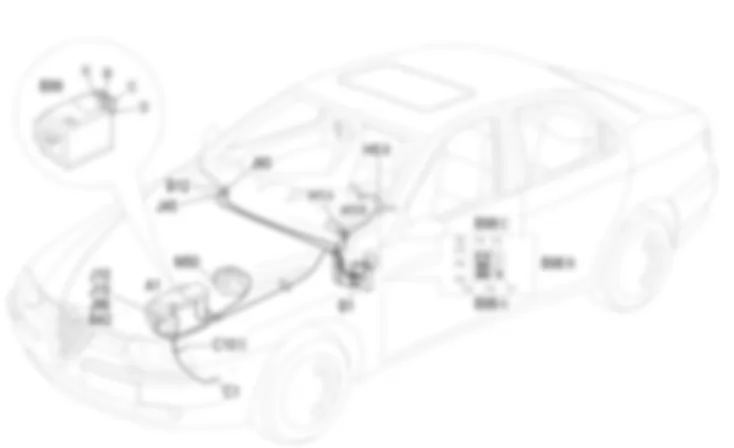
DescriptionThe entire electrical system has been designedand constructed in accordance with the most up-to-date guidelinesconcerning safety and protection, especially against fire risks.There are two main kinds of protection:active protection, aimed at reducing possible causes offaults 'at source';passive protection, aimed at minimizing the effects ofa possible fault.The first category involves careful designof wiring with thorough positioning and anchorage. Wiring is shieldedand protected and the routes are carefully determined. Modifications have therefore been made tothe alternator and starter motor cables, with the adoption of protectivecaps, etc.Passive protection instead includes allthe interventions, which have always been adopted on vehicles, toreduce high fault currents (overload and short circuit).All the fuses included in the system havebeen rated on the basis of the nominal absorption of the loads whichcannot be served simultaneously, and so as to ensure interventionin the case of a definite short circuit.All the electrical systems are suppliedby the battery at a voltage of 12. V. The battery is, in turn, recharged by thealternator 3234399SeeE5010STARTING AND RECHARING duringengine operation. The main supply lines are protected by maxifuses,grouped together in a box directly on the positive battery terminaland connected directly to it.The box contains up to eight maxifuses.The power supplies to all services and systemsare protected by fuses grouped in the junction unit or in two specialmultiple connectors, one for the front wiring and other other forthe facia wiring in accordance with a pre-established order.All the power supplies are thus protected,except for the starter motor cable (battery-starter motor) and rechargingcable (starter motor-alternator): these are protected by an additionalshielded sheath.Some circuits are supplied continuously,even if the vehicle is stopped and the ignition is off, as theyare connected directly to the battery.Other circuits are supplied by turningthe ignition key to various different positions:when the key is inserted and turned to the first click,the ignition is turned on (ON position) and several circuits aresupplied, which are thus called 'ignition-operated' (lines 'INT'and '15/54');the second click - AVV position - instead supplies thestarter motor (line '50')., disconnecting some circuits (thosewhich absorb most power), thus ensuring the maximum flow of currentto the starter motor; ('INT/A' line).on the other hand, by extracting the key and turning itin the opposite direction (and pressing the special button) thePARK position is engaged which supplies the side lights even withthe key switched off ('STAZ' and 'POS' lines);3233770SeeE2010SIDE LIGHTS / NO. PLATE LIGHTS767The lines through which the supplyis distributed to the various electrical devices are shown on thewiring diagrams relating to the various functions and systems.This general diagram shows all the lineswhich depart from the battery and the MAXIFUSE boxes; referenceshould be made to the specific diagrams for greater detail.
Functional description All the electrical equipment and systemsare supplied by the battery A1.The main supply lines are protectedby the MAXIFUSE box B99 which contains the fuses named accordingto the circuits protected:J/B1: supply for services through the junctionunitIGN : ignition switch supply;J/B2 : supply for services through the junctionunitA/C: air conditioning system supplyEFI : supply for fuses and relays for engine managementFAN1 : engine cooling fan supply;F/P: engine cooling fan supply;O/A : automatic transmission supplyThe fuse box also contains two 'MIDI'fuses located directly on the battery and named according to thecircuits protected.ABS: ABS supply: A1, connector C.Other circuits are supplied by turningignition key H1 to various different positions:in the ON position, numerous circuits and services controlledby the ignition (INT line) are supplied.in the AVV position - the starter motor is supplied; (line'50') (3234399SeeE5010STARTING AND RECHARING): In this position several circuits are disconnected (line 'INT/A'.in the PARK position the side lights are supplied ('STAZ'and 'POS' lines);3233770SeeE2010SIDE LIGHTS / NO. PLATELIGHTS
<anchor>0</anchor><span>Removing</span><icon><imageid>20</imageid></icon>1Refitting21Place the car on a ramp.Undo the bolt securing the bracket on thebattery mount.Release the battery from the anchoragebracket complete with strap and remove.
5530B14
769768768
5530B18
Follow these precautions.769On batteries with an opticam hydrometer,electrolyte level and battery charge status can be monitored qualitativelyby examining the indicator colour:a light, bright colour indicates low electrolytelevel: top up with distilled water;a dark colour without a green area in thecentre indicates that the electrolyte level is correct but chargeis low: recharge the battery;a dark colour with a green area in themiddle indicates that both electrolyte level and charge status arecorrect: no action is necessary. For more details 3238420See subassembly5530 CURRENT GENERATOR . 768Proceed as follows.Check the battery voltage without loadusing the test device recommended by the Service outlets (e.g. 'MICRO360').Depending on the voltage values measured,which define the state of charge of the battery, proceed as follows: If the voltage without load is less than12.10 V, replace the battery ( 32384295530B10battery - r+r ). If the voltage without load is over 12.10V but less than 12.50 V, recharge the battery ( 32384305530B14battery - recharge ). If the voltage without load is over 12.50V, the battery is efficient.If necessary, top up the electrolyte asfollows.Carefully remove the cap strip.Top up with distilled and deionized water,taking care not to allow electrolyte to splash out.768
5530B22
<anchor>0</anchor><span>Removing</span><icon><imageid>20</imageid></icon>1Refitting21Place the car on the liftingbridge.1. Open engine compartment cap and disconnect battery negative terminal.2. Disconnect mass terminal on side member.3. Lift the car and disconnect mass terminal on gearbox.4. Lower the car again and remove battery earth lead.2018767
<anchor>0</anchor><span>Removing</span><icon><imageid>20</imageid></icon>1Refitting21Disconnect the battery negative terminal.1. Open the protective cover2. Loosen the nut and disconnect the ABS supply lead3. Loosen the nut and disconnect the starter motor supply lead4. Undo the clip and undo the box retaining bolts.5. Loosen the battery positive terminal nut.2018769
5530B52
<anchor>0</anchor><span>Removing</span><icon><imageid>20</imageid></icon>1Refitting213238429-5530B10battery - r+rRelease the air duct hose from the mountingbracket on the drip tray. Remove the relay shield.1. Release the relays from the battery drip tray and remove them.2. Undo the nut fixing the air filter mounting bracket to the batterydrip tray.3. Undo the two fixing nuts (3a) and move the connections/electricalwiring mounting bracket (3b) aside.4. Release the accelerator cable from the fastening on the bracket.2018771
<anchor>0</anchor><span>Removing</span><icon><imageid>20</imageid></icon>1Refitting213238429-5530B10battery - r+r1. Drain the brake-clutch fluid from the reservoir using a suitablesyringe.2. Disconnect the air inlet pipe from the inlet manifold.2017884
<anchor>0</anchor><span>Removing</span><icon><imageid>20</imageid></icon>1Refitting21Disconnect the battery negative(-) terminal. 1. Disconnect the electrical connection for one of the front wheelrpm sensors.2. Undo the bolt (2a) and remove one of the the front wheel rpmsensors (2b) complete with electrical wiring.2017900
<anchor>0</anchor><span>Removing</span><icon><imageid>20</imageid></icon>1Refitting21Disconnect the battery negative(-) terminal. 1. Disconnect the electrical connection for one of the rear wheelrpm sensors.2. Undo the bolt (2a) and remove the rpm sensor for one of the rearwheels (2b) complete with electrical wiring.2017901
We use cookies to enhance your browsing experience, serve
personalized ads or content, and analyze our traffic. By clicking "Accept All",
you consent to our use of cookies. Privacy Policy