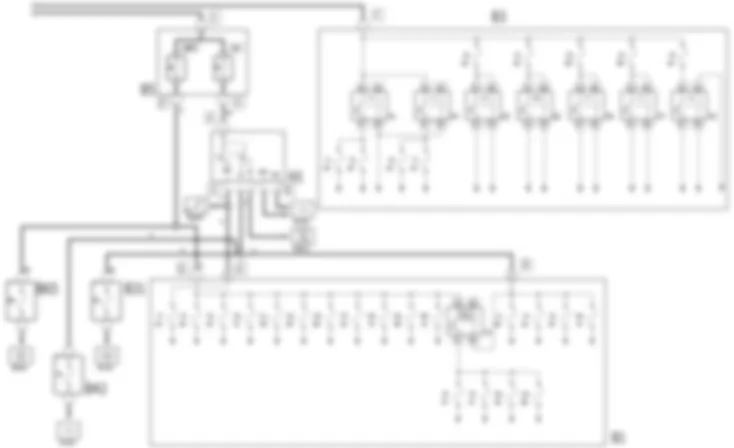
DescriptionThe entire electrical system has been designed and constructed in accordance with the most up-to-date guidelines concerning safety and protection, especially against fire risks.There are two main kinds of protection:active protection, aimed at reducing possible causes of faults 'at source';passive protection, aimed at minimizing the effects of a possible fault.The first kind involves the thoughtful design of wiring, attentive to location and anchorage, and the careful planning of properly protected cable routes.Modifications have therefore been made to the alternator and starter motor cables, with the adoption of protective caps, etc.Passive protection instead includes all the interventions, which have always been adopted on vehicles, to reduce high fault currents (overload and short circuit).All the fuses included in the system have been rated on the basis of the nominal absorption of the loads which cannot be served simultaneously, and so as to ensure intervention in the case of a definite short circuit.All the electrical systems are supplied by the battery at a voltage of 12. V. The battery is in turn recharged by the alternator ( 3309762SeeE5010STARTING AND RECHARING ) during engine operation. The main supply lines are protected by 'MAXIFUSES', grouped together in a container located in the engine compartment services compartment.The power supplies to all services and systems are protected by fuses grouped in the junction units, one of which is inside the passenger compartment and the other one which is in the engine compartment on the left side panel. The unattached fuses are located in the engine compartment near the rear bulkhead and in compartments protected by covers in the luggage compartment, one on the right hand side and the other on the left hand side behind the battery.All the power supplies are thus protected, except for the starter motor cable (battery-starter motor) and recharging cable (starter motor-alternator): these are protected by an additional shielded sheath.Some circuits are supplied continuously, even if the vehicle is stopped and the ignition is off, as they are connected directly to the battery.Other circuits are supplied by turning the ignition key to various different positions:when the key is inserted and turned to the first click, the ignition is turned on (MAR position) and several circuits are supplied, which are thus called 'ignition-operated' (lines 'INTE' and '15/54');the second click - AVV (starting) position - supplies the starter motor (line '50'), disconnecting certain circuits (those which absorb greater power) and thereby guaranteeing the maximum current flow to the actual starter motor; ('INT/A' line).767The lines through which the supply is distributed to the various electrical devices are shown on the wiring diagrams relating to the various functions and systems.This general diagram shows all the lines which depart from the battery and the MAXIFUSE boxes; reference should be made to the specific diagrams for greater detail.
Functional descriptionAll electrical equipment and systems are supplied by battery A1, located in the boot compartment: two junction units distribute power to the various parts of the car.junction unit A6 is located at the rear. This is protected by MAXIFUSE for rear services B4 (60A). It sends power to all services with control units or systems located in the boot compartment.terminal board A5 is located at the front - in the engine bay. This is protected by master power supply MAXIFUSE B2 (125A). It sends power to all services with control units or systems located in the engine bay.The other supply lines leading to junction unit B1 and ignition switch H1 are protected by both MAXIFUSES B5:ACC (30A) for supply to ignition switch H1 ;CENTR (60A) for supply for services via fuses for junction unit B1Other circuits are supplied by turning ignition key H1 to various different positions:certain ignition-operated services are supplied when the key is turned to MAR;in the AVV position - the starter motor is supplied; (line '50') (3309762SeeE5010STARTING AND RECHARING);certain services which are ignition-operated except at start-up are disconnected in this position (INT/A line)
<anchor>0</anchor><span>Removing</span><icon><imageid>20</imageid></icon>1Refitting213314864-5530B54battery cover - r+r . Make sure that the ignition key is in theOFF position.1. Disconnect the battery negative and positive terminals.2. Undo the bolt (2a) fixing the battery retaining bracket (2b).3. Remove the battery.2010647
5530B40
<anchor>0</anchor><span>Removing</span><icon><imageid>20</imageid></icon>1Refitting213314864-5530B54battery cover - r+r1. Press and release the retainers (1a), then remove the cover (1b)for the supply box on the battery. 2071303
<anchor>0</anchor><span>Removing</span><icon><imageid>20</imageid></icon>1Refitting211. Working in the luggage compartment, undo the knob for the batterycover.2. Remove the battery cover.2010650
<anchor>0</anchor><span>Removing</span><icon><imageid>20</imageid></icon>1Refitting21Position the vehicle on the lift. Make sure that the ignition is off (STOPposition), then disconnect the negative battery terminal (referto op. 33148615530B10battery - r+r ). 3315302-7055B54under-engine guard - r r . 3314154-1076B50exhaust pipe attachment to engine - r + r . 1. Undo the bolts (1a) for the starter motor, release the band (1b)and remove the electrical connections protective cover (1c).2010624
<anchor>0</anchor><span>Removing</span><icon><imageid>20</imageid></icon>1Refitting213314824-5505A18multi-function controlunit - r r . 1. Undo the bolt (1a) and push back the junction unit as far asnecessary to disconnect the electrical connections (1b).767For precise identification ofthe electrical connections, see Wiring Diagrams Section.2. Remove the junction unit.2010592
<anchor>0</anchor><span>Removing</span><icon><imageid>20</imageid></icon>1Refitting21 Make sure that the ignitionis off (STOP position), then disconnect the negative battery terminal(refer to op. 33148615530B10battery - r+r ). 1. Unscrew bolt (1a) and open fuse access cover (1b).2. Undo the bolt (2a) and remove the integrated multiservices unit(2b) after having disconnected the electrical connections (2c),(2d), (2e), (2f) and (2g).2010595
5505A29
<anchor>0</anchor><span>Removing</span><icon><imageid>20</imageid></icon>1Refitting21Open the bonnet lid.1. Release the retainers (1a) and remove the cover (1b) for theadditional junction unit.2071293
<anchor>1</anchor><span>Refitting</span><icon><imageid>21</imageid></icon>0Removing20.767The fuel tank is supplied by theParts Dept. together with the multifunction valves (which cannotbe dismantled) and the immersed pump assembly complete with gauge.Therefore if the tank has to be replaced it is not possible to reuse theimmsered pump assembly complete with gauge removed, but a new pre-assembledunit consisting of a tank - pump - multifunction valves suppliedby the Parts Dept. must be fitted.Move the fuel tank closer to its housingusing the hydraulic jack and connect the supply pipes to the fuel vapourseparator.Refit the fuel tank in its seating andsecure with its bolts.Remove the hydraulic jack from under thefuel tank.1. Replace the rear suspension crossmeber (1a) in its housing usingthe hydraulic jack (1b) and fix it tightening the bolts (1c) tothe recommended torque.Remove the hydraulic jack from under thecrossmember.2007293
<anchor>0</anchor><span>Removing</span><icon><imageid>20</imageid></icon>1Refitting21Position the vehicle on the lift.3315188-7040B10load platform (luggage platform) trim - r+r . 3314100-1040A70submerged pump assembly complete with level guagecontrol - r + r . Drain the fuel from the tank using suitableequipment.3314704-4450B11WHEEL (one) rear - R.R. (right) Undo the bolts and remove the rear partof the right rear wheel arch liner.1. Disconnect the connecting pipes to the valves on the tank fromthe fuel vapour separator.2. Disconnect the rapid attachment for the fuel vapour supply pipeto the canister.3. Undo the bolts fixing the fuel filler pipe to the bodyshell.4. Loosen the band fixing the fuel filler pipe to the hose.2007299
<anchor>0</anchor><span>Removing</span><icon><imageid>20</imageid></icon>1Refitting21Open the access flap to the fuel fillerpipe cap.Undo and remove the fuel filler pipe cap.
1040A70
769
1040A74
<anchor>0</anchor><span>Removing</span><icon><imageid>20</imageid></icon>1Refitting21- 7045A10 l/h or r/h front seat (one) - r+r . 1. Cut the floor carpet along the marked line.2. Undo the bolts fixing the inertia switch to the bodyshell.3. Disconnect the electrical connection (3a) and remove the inertiaswitch (3b).2007309