
WIRING DIAGRAM - STARTING AND RECHARING - Fiat 500 1.3 Multijet
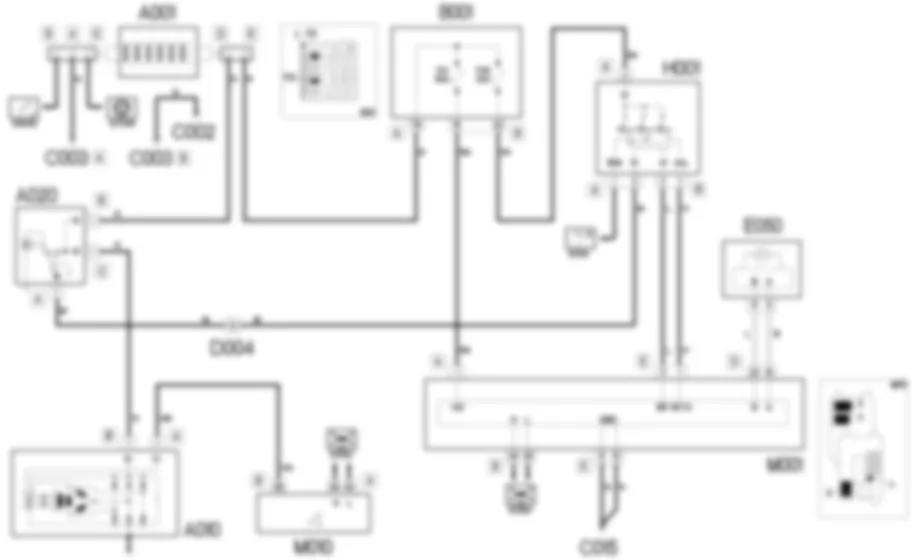
COMPONENTS - STARTING AND RECHARING - Fiat 500 1.3 Multijet
| Component code | Description | Reference to the operation |
| A001 | BATTERY | |
| A010 | ALTERNATOR | |
| A020 | STARTER MOTOR | |
| B001 | JUNCTION UNIT | |
| C002 | BATTERY EARTH ON ENGINE | - |
| C003 | BATTERY EARTH ON BODYSHELL | - |
| C015 | DASHBOARD EARTH, DRIVER'S SIDE | - |
| D004 | FRONT/ENGINE COUPLING | - |
| E050 | INSTRUMENT PANEL | |
| H001 | IGNITION SWITCH | |
| M001 | BODY COMPUTER | |
| M010 | ENGINE MANAGEMENT ECU |
COMPONENT LOCATION - STARTING AND RECHARING - Fiat 500 1.3 Multijet

| Component code | Description | Reference to the operation |
| A001 | BATTERY | |
| A010 | ALTERNATOR | |
| A020 | STARTER MOTOR | |
| B001 | JUNCTION UNIT | |
| C002 | BATTERY EARTH ON ENGINE | - |
| C003 | BATTERY EARTH ON BODYSHELL | - |
| C015 | DASHBOARD EARTH, DRIVER'S SIDE | - |
| D004 | FRONT/ENGINE COUPLING | - |
| E050 | INSTRUMENT PANEL | |
| H001 | IGNITION SWITCH | |
| M001 | BODY COMPUTER | |
| M010 | ENGINE MANAGEMENT ECU |
DESCRIPTION - STARTING AND RECHARING - Fiat 500 1.3 Multijet
The ignition and recharging circuit comprises the battery, starter motor and alternator.The battery (12V) is low maintenance type.The starter motor consists of a d.c. motor supplied by the battery and an excitation electromagnet.When the ignition key is turned as far as it will go (AVV), the motor windings are supplied to generate the electromagnetic forces that are used to turn the starter motor pinion. This simultaneously activates the electromagnet that operates the mechanism, which causes the pinion to mesh with the flywheel ring gear and thus turn the crankshaft.The alternator recharges the battery during normal engine rotation.The alternator shaft (rotor) is turned by the crankshaft via a belt. When supplied by an excitation current, the rotor generates a magnetic field that sets up an alternating current in the fixed winding (stator).A diode rectifier bridge, located at the back of the alternator, transforms the alternating current into a direct current: this recharges the battery.A voltage regulator built into the alternator maintains the power supply at a constant voltage (around 14 V) throughout all load variation and engine speed ranges.The engine control unit and Body Computer monitor the efficiency of the recharging system:
FUNCTIONAL DESCRIPTION - STARTING AND RECHARING - Fiat 500 1.3 Multijet
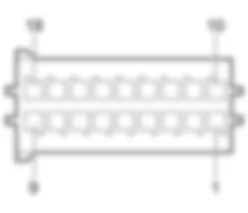
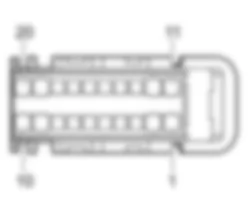
On turning the key in the H001 ignition switch to the end position (AVV), the starter motor A020 (connector A) solenoid winding (50) receives a power supply from pin 3 of connector A.This direct battery power supply reaches the ignition switch H001 (pin 2 of connector A) via the line protected by fuse F03 of the engine compartment junction unit B001 (pin 22 of connector B).Pin +30 (connector B) of the starter motor A020 receives a power supply via a dedicated terminal (connector D) located directly at the positive battery pole A001.During recharging, on the other hand, the direct current produced by the alternator A010 is sent, through the connection between connector B of the actual alternator (B+) and connector C of the starter motor A020, to the battery A001 (connector D).The alternator A010, provides pin 55 of connector B of the engine management control unit M010, with the insufficient recharging signal (D+), via pin 1 of connector A, thereby allowing the fault diagnosis of the operation of the actual alternator (if the recharging level is too low).This signal is forwarded, via the C-CAN, by the control unit M010 (pins 64 and 40 of connector A) to the Body Computer M001 (pins 44 and 45 of connector B) and made available to the network.Once a fault has been discovered, the M001 Body Computer, through the B-CAN, will light up the battery recharging/alternator failure warning light in the E050 instrument panel.The Body Computer M001 receives a direct battery power supply (pin 1 of connector A) protected by fuse F01of the engine compartment junction unit B001 (pin 18 of connector B); it also receives twon ignition-controlled power supplies (INT and INT/A) at pins 11 and 1 of connector E.The Body Computer M001 is also connected to the driver''s dashboard earth C015 via pins 9 and 10 of connector E.