
WIRING DIAGRAM - PARTICLE FILTER SYSTEM - Fiat GRANDE PUNTO 1.9 Multijet
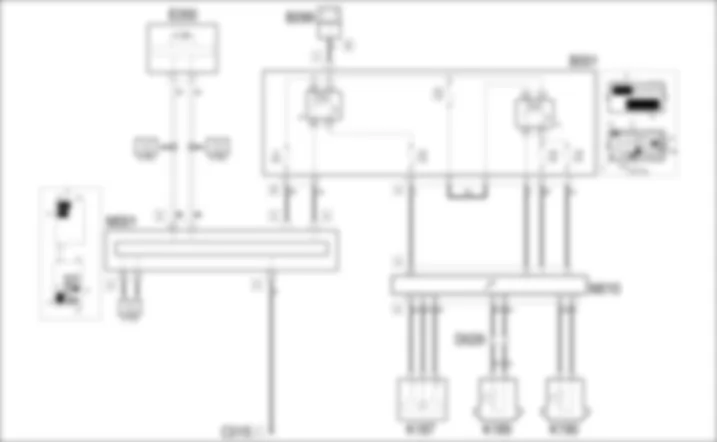
COMPONENTS - PARTICLE FILTER SYSTEM - Fiat GRANDE PUNTO 1.9 Multijet
| Component code | Description | Reference to the operation |
| B001 | JUNCTION UNIT | |
| B099 | MAXI FUSE BOX ON BATTERY | |
| C015 | DASHBOARD EARTH, DRIVER'S SIDE | - |
| D029 | ENGINE CABLES/ENGINE SERVICES CABLE COUPLING | - |
| E050 | INSTRUMENT PANEL | |
| K187 | FAP DIFFERENTIAL PRESSURE SENSOR | |
| K189 | UPSTREAM PARTICULATE FILTER TEMPERATURE SENSOR (DPF) | |
| K190 | DOWNSTREAM PARTICULATE FILTER TEMPERATURE SENSOR (DPF) | |
| M001 | BODY COMPUTER | |
| M010 | ENGINE MANAGEMENT ECU |
COMPONENT LOCATION - PARTICLE FILTER SYSTEM - Fiat GRANDE PUNTO 1.9 Multijet

| Component code | Description | Reference to the operation |
| B001 | JUNCTION UNIT | |
| B099 | MAXI FUSE BOX ON BATTERY | |
| C015 | DASHBOARD EARTH, DRIVER'S SIDE | - |
| D029 | ENGINE CABLES/ENGINE SERVICES CABLE COUPLING | - |
| E050 | INSTRUMENT PANEL | |
| K187 | FAP DIFFERENTIAL PRESSURE SENSOR | |
| K189 | UPSTREAM PARTICULATE FILTER TEMPERATURE SENSOR (DPF) | |
| K190 | DOWNSTREAM PARTICULATE FILTER TEMPERATURE SENSOR (DPF) | |
| M001 | BODY COMPUTER | |
| M010 | ENGINE MANAGEMENT ECU |
DESCRIPTION - PARTICLE FILTER SYSTEM - Fiat GRANDE PUNTO 1.9 Multijet
An electronic control system supervises and governs all engine parameters to optimise performance and fuel consumption by means of a real-time response to different service conditions.To conform with the most recent pollution control regulations (EURO 4), the most recent version of electronic management which includes new components and a swirl solenoid valve and DPF particle filter has been adopted.The DPF particle filter (Diesel Particulate Filter) is a mechanical filter, inserted in the exhaust pipes which traps the carbon particles present in the exhaust gases on diesel engines. The filter makes it possible to almost totally eliminate the emission of carbon particles in line with current legislation.During the normal usage of the vehicle, the engine management control unit records a series of data related to usage (period of usage, type of journey, temperatures reached, etc.) and empirically calculates the quantity of particulates accumulated in the filter.The filter is an accumulation system and should be periodically regenerated (cleaned) by burning the carbon particles.This regeneration is managed by the engine management control unit on the basis of information provided by the sensors and if the following conditions are satisfied: vehicle speed above 40 Km/h for at least 15 minutes and particle mass below 200%.During the procedure the engine management control unit increases the engine speed to 3500 rpm and activates the fans for about 5 minutes; a message is sent at the end and is shown on the panel display.
FUNCTIONAL DESCRIPTION - PARTICLE FILTER SYSTEM - Fiat GRANDE PUNTO 1.9 Multijet
Engine management control unit M10 controls and governs the entire electronic ignition and injection system.The ignition-operated power supply arrives via a line protected by fuse F20 of the engine compartment junction unit B1 at pin 28 of connector A of M10 .Main injection relay T7 of B1 controls the entire system: this is protected by a line protected by fuse F43 of engine compartment control unit B1 and is excited by a control signal (earth) from pin 72 of connector A of control unit M10 and thus sends a power supply:- to pin 1 of connector A of the control unit, via the line of fuse F29 of B1 ;- to pin 5 of connector A of the control unit, via the line of fuse F28 of B1 ;The engine management control unit M10 receives signals from the different sensors thereby keeping all the engine operating parameters in check, in particular there are three specific sensors for the management of the operation of the particle filter.The FAP differential pressure sensor K187 receives a power supply from the control unit M10 from pin 44 of connector A and a reference earth from pin 37 of connector A and sends a signal proportional to the pressure to pin 36 of connector A of M10.The downstream catalyzer temperature sensor K189 receives a reference earth from pin 35 of connector A of the control unit M10 and supplies a signal proportional to the temperature measured at pin 34 of connector A of control unit M10.The downstream catalyzer temperature sensor K190 receives a reference earth from pin 33 of connector A of the control unit M10 and supplies a signal proportional to the temperature measured at pin 32 of connector A of control unit M10.The control unit is then connected via the CAN to the Body Computer M1 and to the instrument panel E50 thereby controlling the switching on of the filter blocked warning light and the displays in the panel.The autodiagnostic data can be read by connecting to connector C of the Body Computer M1 - pin 7: it receives signals from pin 25 of connector A of control unit M10 via the special diagnostic line, through which the command for the forced regeneration using the diagnostic equipment (Examiner) also "passes".