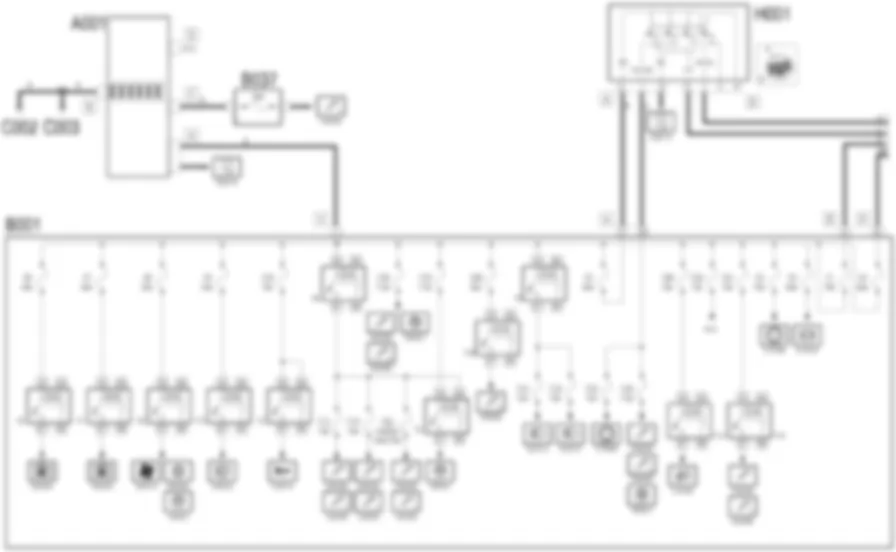
DescriptionThe electrical system has been designed with the safety of the vehicle uppermost, to prevent the risk of fire and the other consequences of electrical malfunctions and to reduce defective connections thanks to the adoption of the latest generation connectors.The distribution of power takes place via the junction units and/or fuse boxes, connected to the control elements (relays and static actuators) in order to ensure the maximum level of electrical protection and the minimum degree of wiring complexity.The distribution of the functions inside the connectors and the replacement of the connections with short circuit type couplings favours modular arrangements (sub-assembly composition) for all cable looms.The main safety solutions adopted are:supplies protected by maxi fuses to cut out the electrical system, in the case of a short circuit (see detail below);the only cables without maxi fuses (starter motor and alternator) are protected and positioned in a safe place;the layout of the entire system is designed to optimize the risk of damage in the case of a failure or accident;the routing of the actual cables has been optimized, reducing incorrect positioning and noise due to vibrations;all the cables are highly resistant to abrasionsthere are special cables in the engine compartment which are resistant to high temperatures and protected with outer casings or pipes;the cables in the passenger compartment are protected by corrugated pipes and plush type bands to reduce noisethe main connections are fitted with anti-slip devices on the terminals (secondary lock) and safety closures (lever lock or CPA) to prevent any distortion of the terminals.All the electrical systems are supplied by the battery at a voltage of 12. V. The battery is, in turn, recharged by the alternator 2399321SeeE5010STARTING AND RECHARING during engine operation. The main supply lines are protected by 'maxifuses' housed in the engine compartment junction unit; other shunt fuses are housed outside it.Some circuits are supplied continuously, even if the vehicle is stopped and the ignition is off, as they are connected directly to the battery.Other circuits are supplied by turning the ignition key to various different positions:when the key is inserted and turned to the first click, the ignition is turned on (MAR position) and several circuits are supplied, which are thus called 'ignition-operated' (lines 'INT' and '15/54');the second click - AVV position - instead supplies the starter motor (line '50')., disconnecting some circuits (those which absorb most power), thus ensuring the maximum flow of current to the starter motor; ('INT/A' line).23The lines through which the supply is distributed to the various electrical devices are shown on the wiring diagrams relating to the various functions and systems.This general diagram shows all the lines which depart from the battery and the MAXIFUSE boxes; reference should be made to the specific diagrams for greater detail.
Functional description All the electrical equipment and systems are supplied by the battery A1 . The main supply lines are protected by the engine compartment junction unit B1 fuses, in particular:F1 underdashboard junction unit supply B2, at pin A of connector C;F4 underdashboard junction unit supply B2, at pin B of connector C and additional fuse box B98;F3 ignition switch H1 supply.Other circuits are supplied by turning ignition key H1 to various different positions:in the ON position, numerous circuits and services controlled by the ignition (INT line) are supplied ('INT' and '15/54' lines): pin 2 of connector B and 1 of connector A;in the AVV position - the starter motor is supplied; (line '50')2399321SeeE5010STARTING AND RECHARING; in this position several circuits are disconnected ('INT/A' line): 1 of connector B;
<anchor>0</anchor><span>Removing</span><icon><imageid>20</imageid></icon>1Refitting21Open the bonnet lid and disconnectthe battery.1. Undo the nut.2. Move aside the retainer.3. Remove the battery carefully.2050795
5530B22
<anchor>0</anchor><span>Removing</span><icon><imageid>20</imageid></icon>1Refitting212400577-5530B10battery - r+r2400580-5530B52Battery DRIP TRAY/SUPPORT - R.R.Open the bonnet lid.1. Disconnect the electrical connection (1a) from the negative batteryterminal (1b).2. Disconnect the electrical connection from the bodyshell3. Disconnect the electrical connection from the gearbox casing.4. Keep the battery earth lead.2050796
5530B36
<anchor>0</anchor><span>Removing</span><icon><imageid>20</imageid></icon>1Refitting21Place the vehicle on a lift.Raise the car.1. Undo the nut (1a) and disconnect the electrical connections (1b,1c) from the starter motor.2050797
5530B52
<anchor>0</anchor><span>Removing</span><icon><imageid>20</imageid></icon>1Refitting212400577-5530B10battery - r+r1. Open the retaining bands and release the wiring.2. Remove the battery support tray (2a), releasing the dischargepipe (2b) from the passage hole (2c). 3. Undo the bolts.4. Remove the battery cage.2050799
5530B60
<anchor>0</anchor><span>Removing</span><icon><imageid>20</imageid></icon>1Refitting21Open the bonnet lid.1. Undo the nut.2. Undo the retaining buttons using the special tool3. Remove the belt.2050800
<anchor>0</anchor><span>Removing</span><icon><imageid>20</imageid></icon>1Refitting21Open the bonnet lid.1. Release the retainers (1a) and remove the cover (1b).2050746
<anchor>0</anchor><span>Removing</span><icon><imageid>20</imageid></icon>1Refitting212400802-7040A37fuse box cover - r r1. Disconnect the electrical connections (1a, 1b, 1c, 1d, 1e, 1f).2. Undo the bracket retaining bolt.3. Slightly move the bracket (3a) for the dashboard trim and undothe bolt (3b).4. Undo the other bolts securing the body computer/junction unit.5. Slightly move the body computer/junction unit assembly.6. Disconnect the electrical connections (6a, 6b, 6c).7. Recover the body computer/junction unit.2050752
<anchor>0</anchor><span>Removing</span><icon><imageid>20</imageid></icon>1Refitting211. Disconnect electronic control unit electrical connections (1a),(1b), (1c).2. Undo the bolts.3. Recover the control unit.2050753
<anchor>0</anchor><span>Removing</span><icon><imageid>20</imageid></icon>1Refitting211. Disconnect electronic control unit electrical connections (1a),(1b), (1c).2. Undo the bolts.3. Recover the control unit.2050754
We use cookies to enhance your browsing experience, serve
personalized ads or content, and analyze our traffic. By clicking "Accept All",
you consent to our use of cookies. Privacy Policy