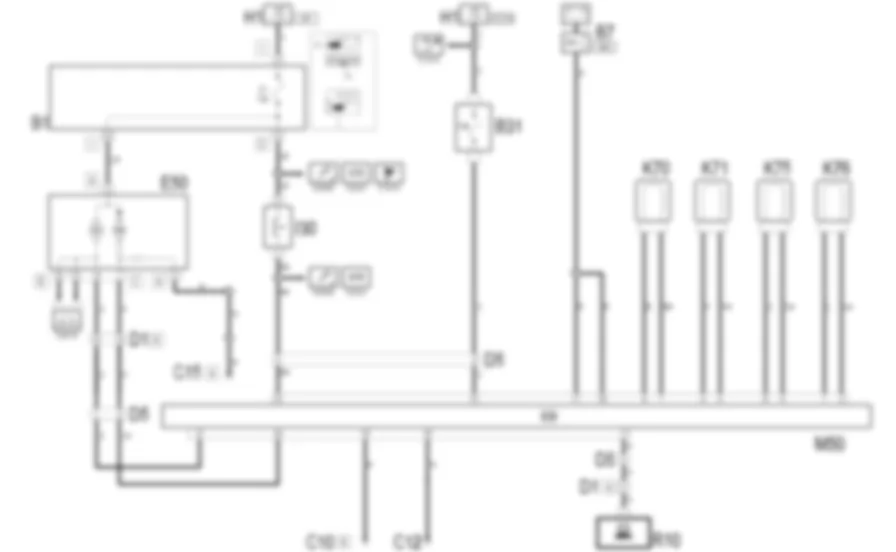
Wiring diagramComponents
| Component code | Name | Assembly reference |
| B1 | Junction unit | B7 | Fuse (MAXI FUSE) for ABS | - |
| B31 | ABS fuse | - |
| C10 | Left front earth | - |
| C10 | Left front earth | - |
| C12 | ABS front earth | - |
| C15 | Facia earth, driver's side | - |
| D1 | Front/facia junction | - |
| D5 | Front ABS coupling | - |
| D5 | Front ABS coupling | - |
| E50 | Instrument panel | H1 | Ignition switch | I030 | Brake pedal switch ( FRONT ) | K70 | Front wheel sensor left for ABS | K70 | Front wheel sensor left for ABS | K71 | Front wheel sensor RH for ABS | K71 | Front wheel sensor RH for ABS | K75 | Left rear wheel sensor for ABS | K75 | Left rear wheel sensor for ABS | K76 | Rear right wheel sensor for ABS | K76 | Rear right wheel sensor for ABS | M50 | ABS control unit | R10 | Multiple tester connection | - |
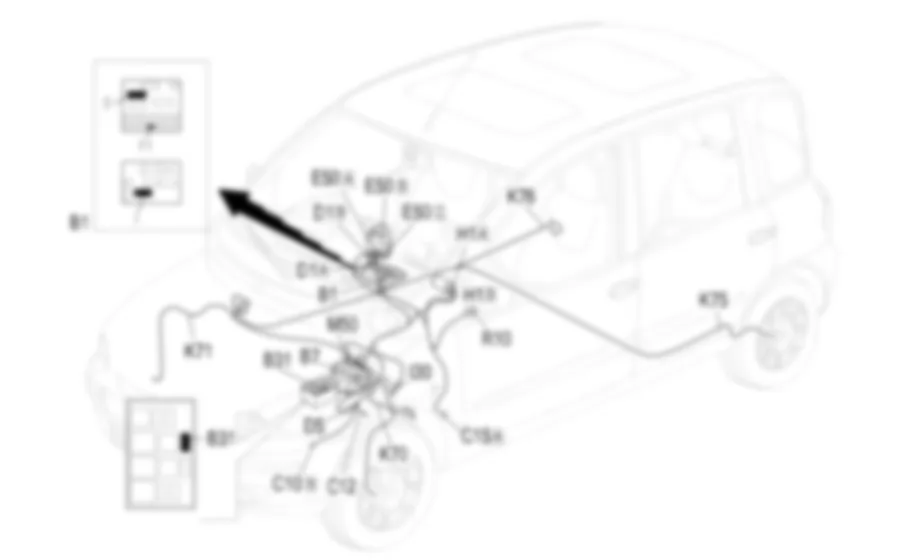
Location of componentsComponents
| Component code | Name | Assembly reference |
| B1 | Junction unit | B7 | Fuse (MAXI FUSE) for ABS | - |
| B31 | ABS fuse | - |
| C10 | Left front earth | - |
| C10 | Left front earth | - |
| C12 | ABS front earth | - |
| C15 | Facia earth, driver's side | - |
| D1 | Front/facia junction | - |
| D5 | Front ABS coupling | - |
| D5 | Front ABS coupling | - |
| E50 | Instrument panel | H1 | Ignition switch | I030 | Brake pedal switch ( FRONT ) | K70 | Front wheel sensor left for ABS | K70 | Front wheel sensor left for ABS | K71 | Front wheel sensor RH for ABS | K71 | Front wheel sensor RH for ABS | K75 | Left rear wheel sensor for ABS | K75 | Left rear wheel sensor for ABS | K76 | Rear right wheel sensor for ABS | K76 | Rear right wheel sensor for ABS | M50 | ABS control unit | R10 | Multiple tester connection | - |
DescriptionThe electronic anti-lock brake system (BOSCH 5.3 ABS) governs braking pressure sent to the wheels and prevents loss of grip under all tyre and road surface conditions. The system is designed to complement the normal mechanical braking system and not to replace it. In this way it ensures effective safety in the case of anomalies: the ABS uses the same fluid as the conventional mechanical braking system.Four sensors fitted to the four wheels inform the electronic control unit of wheel speed at every moment. In this way, they detect wheel lock, wheel slip and loss of grip. Under these conditions, the control unit sends specific instructions to solenoids that modulate hydraulic circuit pressure to eliminate lock and restore the car to within grip limits. This ensures the shortest possible stopping distance, without losing control of the steering.Two adjustment solenoids (one for pressure charging, the other for pressure discharging) are fitted for each wheel.The sensors are active, i.e. they consist of a Hall-effect receiver that faces a magnetic coding device built into the hub bearing. Under these conditions, the signal is less influenced by electromagnetic interference and temperature.The control unit also controls brakeforce distribution over the rear axle and thus replaces the mechanical lload proportioning valve used previously (EBD function: Electronic Brake Distribution).The control unit is equipped with a self-diagnostic function: when an error occurs in the ABS system, a warning light is turned on and the system is simultaneously deactivated. Under these conditions, the car brakes using only the conventional system.When the control unit detects an error in the EBD function, it simultaneously turns on the "insufficient brake fluid level" and "handbrake on" warning light as well as the ABS warning light.Under these conditions, the rear brake distribution control is also deactivated and the car must be driven with great care. For more details 2888263see DESCRIPTION AND OPERATION:3340A(B.S. ANTI-LOCK BRAKING SYSTEM .)The supply lines for the control unit and the various system components (sensors and actuators) are protected by a special maxifuse, located near the control unit, and by a fuse in the engine compartment in the relay and fuse box. Functional description ABS electronic control unit M50 is supplied (at pin 17 and 18) directly by the battery via a line protected by ABS maxifuse B7. The supply controlled by the ignition (15/54) reaches pin 15 from the line protected by the specific fuse B31. The control unit is earthed via pins 19 and 16. The four sensors K70, K71, K75, K76 send wheel speed signals to pins 6-7, 4-5, 8-9 and 1-2, respectively of M50. The brake pedal switch I30 sends a go ahead signal to pin 14 of the control unit M50: in effect, the operation of the ABS is excluded unless the brake pedal is pressed; this signal arrives from the line controlled by the ignition (INT) protected by fuse F1 of the junction unit (it is the same signal which switches on the lights - See E2021 BRAKE LIGHTS ) If the control unit M50 detects problems relating to the ABS function, it sends the instrument panel E50 a signal, from pin 20, which lights up the "ABS failure" warning light.767the "ABS failure" warning light is a so-called "intelligent" light: thanks to a special operating circuit inside the instrument, it not only comes on to signal a fault in the ABS system, but also if there is no connection or a short circuit to earth in the circuit which connects the instrument with the control unitIf the problems involve the EBD function, the control unit also sends a signal from pin 21 to the "insufficient brake fluid level and handbrake" warning light which comes on together with the "ABS failure" warning light. This is an earth signal and makes the warning light come on because the instrument panel E50 supply is controlled by the ignition (INT) from the line protected by fuse F1 of the junction unit B1. The autodiagnostic data can be read by connecting to connector R10: it receives signals from pin 11 of the control unit M50 via the special diagnostic line.
Junction unit
B001A
B001A
B001C
B001C
B001D
B001E
B001E
B001E
B001F
B001G
B001H
B001H
B001H
B001I
B001I
B001I
B001J
B001J
B001B
B001B
B001B
B001B
B001B
B001B
B001C
B001C
B001C
B001C
B001C
B001C
B001C
B001D
B001D
B001D
B001D
B001D
B001D
B001D
B001E
B001E
B001E
B001G
B001G
B001G
B001H
B001H
B001H
B001H
B001H
B001I
B001I
B001J
B001J
B001B
B001B
B001B
B001C
B001C
B001C
B001D
B001D
B001D
B001H
B001H
B001H
B001I
B001J
Junction unit
B001A
B001A
B001C
B001C
B001D
B001E
B001E
B001E
B001F
B001G
B001H
B001H
B001H
B001I
B001I
B001I
B001J
B001J
B001B
B001B
B001B
B001B
B001B
B001B
B001C
B001C
B001C
B001C
B001C
B001C
B001C
B001D
B001D
B001D
B001D
B001D
B001D
B001D
B001E
B001E
B001E
B001G
B001G
B001G
B001H
B001H
B001H
B001H
B001H
B001I
B001I
B001J
B001J
B001B
B001B
B001B
B001C
B001C
B001C
B001D
B001D
B001D
B001H
B001H
B001H
B001I
B001J
ABS fuse
B031
B031
Left front earth
C010A
C010B
C010C
C010C
C010D
C010D
C010A
C010A
C010A
C010A
C010A
C010A
C010A
C010A
ABS front earth
C012
C012
Facia earth, driver's side
C015A
C015A
C015B
C015B
C015
C015A
C015A
C015B
C015B
C015
Front/facia junction
D001A
D001A
D001A
D001A
D001A
D001A
D001A
D001A
D001A
D001A
D001A
D001A
D001B
D001B
D001B
D001B
D001B
D001B
D001B
D001B
D001B
D001B
D001B
D001C
D001A
D001A
D001A
D001A
D001A
D001A
D001A
D001A
D001C
D001C
D001C
D001C
D001C
D001C
D001C
D001C
D001A
D001C
D001C
Front ABS coupling
D005
D005
D005
D005
D005
Instrument panel
E050A
E050A
E050A
E050A
E050A
E050B
E050B
E050B
E050B
E050B
E050B
E050B
E050C
E050C
E050A
E050B
E050C
E050C
E050A
E050C
Instrument panel
E050A
E050A
E050A
E050A
E050A
E050B
E050B
E050B
E050B
E050B
E050B
E050B
E050C
E050C
E050A
E050B
E050C
E050C
E050A
E050C
Instrument panel
E050A
E050A
E050A
E050A
E050A
E050B
E050B
E050B
E050B
E050B
E050B
E050B
E050C
E050C
E050A
E050B
E050C
E050C
E050A
E050C
Instrument panel
E050A
E050A
E050A
E050A
E050A
E050B
E050B
E050B
E050B
E050B
E050B
E050B
E050C
E050C
E050A
E050B
E050C
E050C
E050A
E050C
Instrument panel
E050A
E050A
E050A
E050A
E050A
E050B
E050B
E050B
E050B
E050B
E050B
E050B
E050C
E050C
E050A
E050B
E050C
E050C
E050A
E050C
Instrument panel
E050A
E050A
E050A
E050A
E050A
E050B
E050B
E050B
E050B
E050B
E050B
E050B
E050C
E050C
E050A
E050B
E050C
E050C
E050A
E050C
Instrument panel
E050A
E050A
E050A
E050A
E050A
E050B
E050B
E050B
E050B
E050B
E050B
E050B
E050C
E050C
E050A
E050B
E050C
E050C
E050A
E050C
Instrument panel
E050A
E050A
E050A
E050A
E050A
E050B
E050B
E050B
E050B
E050B
E050B
E050B
E050C
E050C
E050A
E050B
E050C
E050C
E050A
E050C
Instrument panel
E050A
E050A
E050A
E050A
E050A
E050B
E050B
E050B
E050B
E050B
E050B
E050B
E050C
E050C
E050A
E050B
E050C
E050C
E050A
E050C