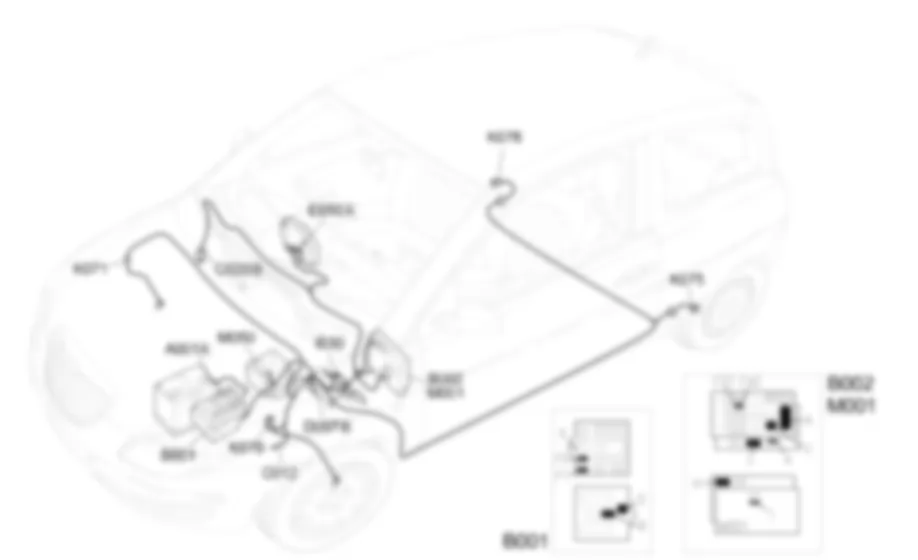
DescriptionThe electronic anti-lock brake system ABS governs braking pressuresent to the wheels and prevents loss of grip under all tyre androad surface conditions.The system is designed to be integratedwith the braking system (using the same hydraulic fluid) withoutpreventing the operation of the braking system if the operationof the ABS fails.Four sensors fitted to the four wheels informthe electronic control unit of wheel speed at every moment. In thisway, they detect wheel lock, wheel slip and loss of grip.Under these conditions, the control unitsends specific instructions to solenoids that modulate hydrauliccircuit pressure to eliminate lock and restore the car to withingrip limits which allows optimum driveability and stopping distances.The sensors are the 'active' type, i.e.supplied by the control unit; they consist of a receiver that facesa magnetic coding device built into the hub bearing so that thesignal is less influenced by electromagnetic interference and variationsin temperature.The ABS control unit also controls brakeforce distribution of the rear axle in relation to the front axle,allowing the mechanical load proportioning device used previouslyto be dispensed with (EBD function: Electronic Brake Distribution).The control unit is equipped with a self-diagnosticfunction: when an error is detected in the ABS function the warninglight comes on and the system is simultaneously deactivated; Underthese conditions, the car brakes using only the conventional system.When the control unit detects an error whichalso affects the operation of the EBD logic, the 'ABS failure' warninglight and the 'insufficient brake fluid level' and 'handbrake applied'warning light comes on.768
767Under these conditions, the rearbrake distribution control is also deactivated: the customer musttherefore drive very carefully to the first service centre.
The ABS control unit also implements theESP (Electronic Stability Program) and ASR (Anti Slip Regulation)functions controlling the stability of the vehicle and also theHBA (Hydraulic Brake Assist) and HH functions. (Hill Holder) 2428122SeeE7023ESP For more details 2427423Characteristic of working principle3340A(B.S. ANTI-LOCK BRAKINGSYSTEM .) . The ABS control unit computes vehicle speedon the basis of values supplied by drive wheel sensors (the ABScontrol unit computes an average reading) and true wheel circumferencesupplied by the body computer. This speed signal is then sent tonodes that require the information via the CAN network. The ABScontrol unit also generates a discrete signal that copies the vehiclespeed information computed and transmitted via the CAN network.The control unit supply lines are protectedby a special maxifuse located in the engine bay control unit. ignition-operatedpower supply from a special fuse in the underfacia control unit.
Functional description ABS electronic control unit M50 is supplied (at pins 12 and25) directly by the battery by the line protected by maxifuse F5of the engine compartment junction unit B1. The ignition-operated supply (INT/A) reachespin 23 from the line protected by the fuse F42 of under faciacontrol unit B2.The control unit is earthed via pins 11and 24. The four sensors K70, K71, K75, K76 sendwheel speed signals tp pins 20-19, 8-7, 22-21, 10-9 of M50, respectively. Brake pedal switch I30 sends an enablementsignal to pin 17 of control unit M50: the ABS cannot intervene unlessthe brake pedal is pressed. The switch I30 is suppliedwhen the ignition is switched on (INT) from fuse F37 of junctionunit B2 . Pin 16 of M50 emits a discrete speedsignal that is sent tol Body Computer M1; the same signal isalso copied via the CAN network. Pins 1 and 2 of ABS control unit M50connect to engine control unit M10, Body Computer M1 and and instrumentpanel E50 to control the ABS warning light and - if the problemlies in the EBD function - the low brake fluid level and handbrakewarning lights. The special 'fault' warning light comes on ifthere is a problem with one of the above mentioned warning lights. Self-diagnostic data can be read by connectingto connector C of Body Computer M1- pin 1: it receives signalsfrom pin 6 of the control unit M50 via the special diagnostic line.2428143SeeE8010DIAGNOSTIC MULTIPLE CONNECTOR
<anchor>0</anchor><span>Removing</span><icon><imageid>20</imageid></icon>1Refitting21Ensure that the ignition key is in theOFF position, then loosen the bolt and disconnect the battery negative(-) terminal.Undo the bolt and disconnect the batteryterminal (+).Undo the battery belt nut.Remove the battery.
5530B22
<anchor>0</anchor><span>Removing</span><icon><imageid>20</imageid></icon>1Refitting212429398-5530B10battery - r+r2429401-5530B52Battery DRIP TRAY/SUPPORT - R.R.Open the bonnet lid.1. Disconnect the electrical connection (1a) from the negative batteryterminal (1b).2. Disconnect the electrical connection from the bodyshell.3. Disconnect the electrical connection from the gearbox casing.4. Keep the battery earth lead.2052930
5530B36
<anchor>0</anchor><span>Removing</span><icon><imageid>20</imageid></icon>1Refitting21Place the vehicle on a lift.Raise the car.1. Undo the nut (1a) and disconnect the electrical connections (1b,1c) from the starter motor.2052931
5530B52
<anchor>0</anchor><span>Removing</span><icon><imageid>20</imageid></icon>1Refitting21 Proceed with removal 2429398-5530B10battery - r+r . 1. Remove drip tray.2. Undo the fixing bolts (2a) and remove the battery cradle (2b)after releasing the electrical wiring from the bands on the cradle.2045035
<anchor>0</anchor><span>Removing</span><icon><imageid>20</imageid></icon>1Refitting21Open the bonnet lid.1. Release the retainers (1a) and remove the cover (1b).2044997
<anchor>0</anchor><span>Removing</span><icon><imageid>20</imageid></icon>1Refitting212429579-7040A30Left instrument panellower TRIM - R.R.1. Disconnect the electrical connections (1a, 1b, 1c, 1d, 1e, 1f).2. Undo the left-threaded bolt securing the facia trim mount beam.3. Undo the bolts securing the body computer/junction unit.4. Move facia trim (4a) slightly and move body computer/junctionunit (4b) downwards.5. Disconnect the electrical connections (5a, 5b, 5c).6. Recover the body computer/junction unit.2045005
<anchor>0</anchor><span>Removing</span><icon><imageid>20</imageid></icon>1Refitting211. Disconnect electronic control unit electrical connections (1a),(1b), (1c).2. Undo the bolts.3. Recover the control unit2045007
<anchor>0</anchor><span>Removing</span><icon><imageid>20</imageid></icon>1Refitting211. Disconnect electronic control unit electrical connections (1a),(1b), (1c).2. Undo the bolts.3. Recover the control unit2045008
<anchor>0</anchor><span>Removing</span><icon><imageid>20</imageid></icon>1Refitting21Ensure that the ignition key is in OFFposition, then disconnect the battery negative terminal (-).1. Disconnect the brake light switch electrical connection.2. Turn and remove the brake light switch.2045071
5550D16
<anchor>0</anchor><span>Removing</span><icon><imageid>20</imageid></icon>1Refitting21Open the tailgate.1. Prise up the rubber pads.2. Press the tail-light retainers in the arrowed direction and releasefrom the seat.2045072
<anchor>0</anchor><span>Removing</span><icon><imageid>20</imageid></icon>1Refitting21Ensure that the ignition key is in OFFposition, then disconnect the battery negative terminal (-).1. Disconnect the electrical connection from the reversing lightsswitch.2. Undo and remove the reversing lights switch.2045076
<anchor>0</anchor><span>Removing</span><icon><imageid>20</imageid></icon>1Refitting21 Proceed with removal 2429398-5530B10battery - r+r . Proceed with removal 2429401-5530B52Battery DRIP TRAY/SUPPORT- R.R. . 1. Remove the protective cap on the brake caliper bleed valve.2. Connect the collection system (pipe and reservoir) to the bleedvalve on the brake caliper.3. Loosen the bleed valve on the brake caliperWait for the brake-clutch reservoir todrain.2044760
<anchor>0</anchor><span>Removing</span><icon><imageid>20</imageid></icon>1Refitting21.767The following procedure describesremoval/refitting of the left rear wheel rpm sensor; proceed asfor the right rear wheel rpm sensor.Position the vehicle on the ramp.Ensure that the ignition key is in OFFposition, then disconnect the battery negative terminal (-).1. Undo the bolt (1a) and remove the rear wheel rpm sensor (1b).2. Release the rear wheel rpm sensor electrical wiring from theattachments on the rear suspension.2044773
We use cookies to enhance your browsing experience, serve
personalized ads or content, and analyze our traffic. By clicking "Accept All",
you consent to our use of cookies. Privacy Policy