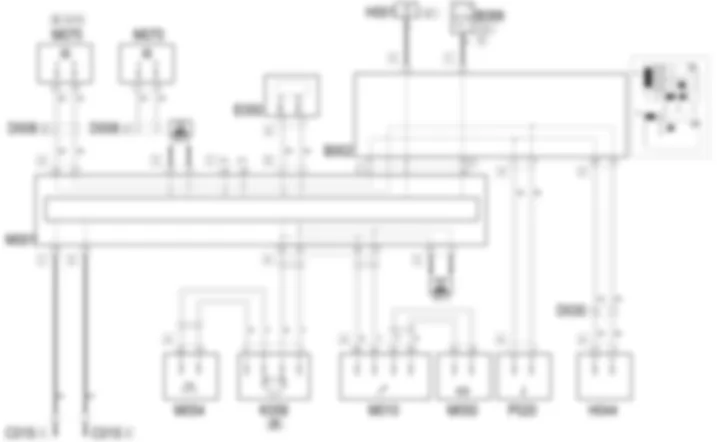
Wiring diagram - CAN CONNECTION LINES - Alfa Romeo GT 2.0 JTS
Components - CAN CONNECTION LINES - Alfa Romeo GT 2.0 JTS
| Component code | Description | Reference to the assembly |
| B2 | JUNCTION UNIT UNDER DASHBOARD | |
| B99 | MAXIFUSE BOX ON BATTERY | |
| D8 | FRONT/AIR CONDITIONING - HEATER COUPLING | - |
| D20 | REAR DASHBOARD COUPLING ( REAR ) | - |
| D30 | REAR COUPLING FOR /FRONT DOOR. DRIVER''S SIDE | - |
| D31 | RIGHT FRONT DOOR REAR COUPLING/. | - |
| D97 | SHORT CIRCUITING COUPLING | - |
| E50 | INSTRUMENT PANEL | |
| H1 | IGNITION SWITCH | |
| H44 | ELECTRIC WINDOWS CONTROLS ASSEMBLY ON DRIVER''S DOOR | |
| K58 | STEERING SENSOR ( FRONT ) | |
| M1 | BODY COMPUTER | |
| M10 | ENGINE MANAGEMENT ECU | 1056B |
| M10 | ENGINE MANAGEMENT ECU | 1060G |
| M50 | ABS CONTROL UNIT ( FRONT ) | |
| M54 | SELESPEED TRANSMISSION CONTROL UNIT | 2127E |
| M70 | CLIMATE CONTROL SYSTEM CONTROL UNIT | |
| P20 | RADIO | |
| P20 | RADIO | |
Component location - CAN CONNECTION LINES - Alfa Romeo GT 2.0 JTS
Components - CAN CONNECTION LINES - Alfa Romeo GT 2.0 JTS
| Component code | Description | Reference to the assembly |
| B2 | JUNCTION UNIT UNDER DASHBOARD | |
| B99 | MAXIFUSE BOX ON BATTERY | |
| D8 | FRONT/AIR CONDITIONING - HEATER COUPLING | - |
| D20 | REAR DASHBOARD COUPLING ( REAR ) | - |
| D30 | REAR COUPLING FOR /FRONT DOOR. DRIVER''S SIDE | - |
| D31 | RIGHT FRONT DOOR REAR COUPLING/. | - |
| D97 | SHORT CIRCUITING COUPLING | - |
| E50 | INSTRUMENT PANEL | |
| H1 | IGNITION SWITCH | |
| H44 | ELECTRIC WINDOWS CONTROLS ASSEMBLY ON DRIVER''S DOOR | |
| K58 | STEERING SENSOR ( FRONT ) | |
| M1 | BODY COMPUTER | |
| M10 | ENGINE MANAGEMENT ECU | 1056B |
| M10 | ENGINE MANAGEMENT ECU | 1060G |
| M50 | ABS CONTROL UNIT ( FRONT ) | |
| M54 | SELESPEED TRANSMISSION CONTROL UNIT | 2127E |
| M70 | CLIMATE CONTROL SYSTEM CONTROL UNIT | |
| P20 | RADIO | |
| P20 | RADIO | |
Description - CAN CONNECTION LINES - Alfa Romeo GT 2.0 JTS
This vehicle is equipped with a CAN (Controller Area Network) system of electrical connections: it involves a software and hardware solution which is designed to manage the resources on the vehicle efficiently allowing:the sharing of information between the various electronic units;the intergration of several electronic units through one network;a high network information exchange speed;advantages in economic terms because there is a considerable reduction in the wiring/connectors inside the vehicle;superior standards in terms of quality and reliability.
The advantage of using a CAN system stems from the fact that communication takes place between numerous control units and consequently the number of signals to be managed is very high.For this reason the signals travel on a CAN type serial Bus where one wire is high level (H) and the other low level (L); these signals on the CAN Bus are differential types, i.e. the value assigned to the bit is represented by the difference between the CAN-H and CAN-L voltage levels.The different electronic units which make up the system, known as network nodes, are connected to the CAN by means of communication interfaces known as transreceivers; these connection interfaces, integrated in the electronic units, constitute the gate for sending/reading the information at the CAN or at the serial lines.The exchange of information at CAN type serial lines is only possible using a transmission protocol which is the collection of rules that allow communication between two or more nodes by means of the exchange of information or "data packages".The main element of the network is the Body Computer.The Body Computer node is entrusted with "waking up the network" when the ignition key is turned to the ON position (if there is a problem with the Body Computer this task is entrusted to other nodes.The Body Computer also carries out the functions of checking the network which make it possible to provide information on:the network activities status;the functional failure status of the individual electronic units (nodes);a possible CAN fault.
The various electronic units process the various signals coming from the corresponding sensors both for their own management and for other control units to which they are sent via the CAN.The specific structure adopted for this vehicle consists of two CAN communication networks which connect nodes belonging to two different areas:C-CAN for dynamic vehicle control (high speed): bus CAN-H and CAN-L;B-CAN for the management of standard body functions (low speed): bus CAN-A and CAN-B;
the two CAN communication networks are connected to one another by a gateway for transferring joint information, located in the Body Computer Node.The following nodes are connected to the Body Computer via the C-CAN:engine management control unit;ABS control unit;SELESPEED gearbox control unit;steering sensor unit for VDC.
The following nodes are connected to the Body Computer via the B-CAN:climate control sytem control unit;Instrument panel;radio or built-in radio-telephone-navigatorcontrols unit on the driver''s door
Nodes connected to the bodywork network are diagnosed via the CAN, while the dynamic car control network is diagnosed by a specific K lines.The system also uses "traditional" complementary serial lines for the various connections; for example in the connection between the Body Computer and the siren/volumetric sensors.Power is distributed via the junction units and/or fuses boxes. These are connected to control elements (relays and static actuators) to ensure maximum electrical protection and minimum complexity..
Operational description - CAN CONNECTION LINES - Alfa Romeo GT 2.0 JTS
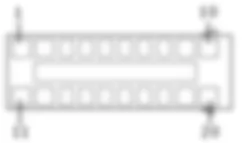
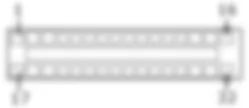
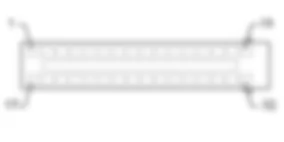
The Body Computer M1receives a direct supply from the battery through the line protected by the CPL maxifuse ( B99, connector B) at pin 18 of connector F of the interface with the junction unit under the dashboard B2.The Body Computer M1receives an ignition-operated supply (INT) at pin 9 of connector F of the interface with the junction unit under the dashboard B2this signal is used, amongst other things, to "wake up the network".Pin 10 of connector C and pin 8 of connector D M1are earthed.The following nodes are connected to the Body Computer M1 via the C-CAN:engine management control unit M10;ABS control unit M50 (which is not connected directly, but via M10 );steering sensor unit for VDC K58 ;SELESPEED gearbox control unit M54 if fitted (which is not connected directly, but via K58 )
The following nodes are connected to the Body Computer M1 via the B-CAN:climate control sytem control unit M70;instrument panel E50;radio or built-in radio-telephone-navigator P20 ;controls unit on the driver''s door H44 .
Junction unit under dashboard
B2A
B2A
B2A
B2A
B2A
B2A
B2B
B2B
B2C
B2C
B2D
B2E
B2F
B2G
B2H
Maxifuse box on battery
B99A
B99A
B99B
B99D
Front coupling air conditioner with heating
D8A
D8A
D8B
D8B
Rear dashboard coupling
D20
D20
D20
D20
Rear coupling for front door driver's side
D30
D30
D30
Front passenger door rear coupling
D31
D31
D31
Short circuiting coupling
D97A
D97A
D97A
D97C
D97D
D97E
D97G
D97H
D97I
D97M
Instrument panel
E50A
E50B
Ignition switch
H1A
H1A
H1B
Electric window controls on front door
H44A
H44B
Steering sensor
K58
Body computer
M1A
M1A
M1A
M1A
M1A
M1A
M1B
M1C
M1D
M1E
M1F
M1G
Engine management control unit
M10A
M10A
M10A
M10B
M10B
M10B
ABS control unit
M50
M50
M50
Selespeed transmission control unit
M54A
M54B
Radio
P20A
P20A
P20B
P20B
P20B
P20B
P20C
P20C
P20C
P20C
P20D
P20C